At 34, I left a largely manual administrative job and started over in a two-year UX design programme. I had never worked as a designer, and I had barely used AI.
The first year gave me a foundation: user-centred design, usability heuristics, accessibility and agile methods, applied in school projects. So when my first eight-week internship began, I expected to finally use it all: research users, map journeys, prototype, test.
Instead, I was introduced to something I had never worked with: AI-assisted product development.
Handed the keys to a moving car
I joined Cway, a Swedish startup building a B2B SaaS platform for the FMCG industry, the companies behind the food and drinks on supermarket shelves.
On day one I got a work email, Slack, Linear, GitHub, access to the product and a Claude account. It felt less like onboarding and more like being handed the keys to a moving car. I had never worked in a product team, touched a codebase or used AI professionally.
The team was five people, and everyone wore several hats. The CEO was also product owner; the CTO also wrote code. My supervisor worked mostly remotely. And I was the only UX designer, with no handbook and no design team to learn from.
The process I knew didn’t fit
At school, projects followed a clear sequence:
- Research
- user needs
- problem definition
- ideas
- wireframes
- prototype
- test
A startup doesn’t have the time or people for a textbook process. So for the first two weeks, I did what I knew. I talked to sales and the CEO about users and their problems, tested the product myself, logged usability issues and mapped competitors. I ended up with personas, user flows and problem statements.
Then I opened Figma to start designing.
“We don’t use Figma”
My CEO looked over and said: “We don’t use Figma.”
I had spent a year living in Figma. I thought in components and variables. Some nights I dreamed in auto-layout.
“We gave you the tool,” he added.
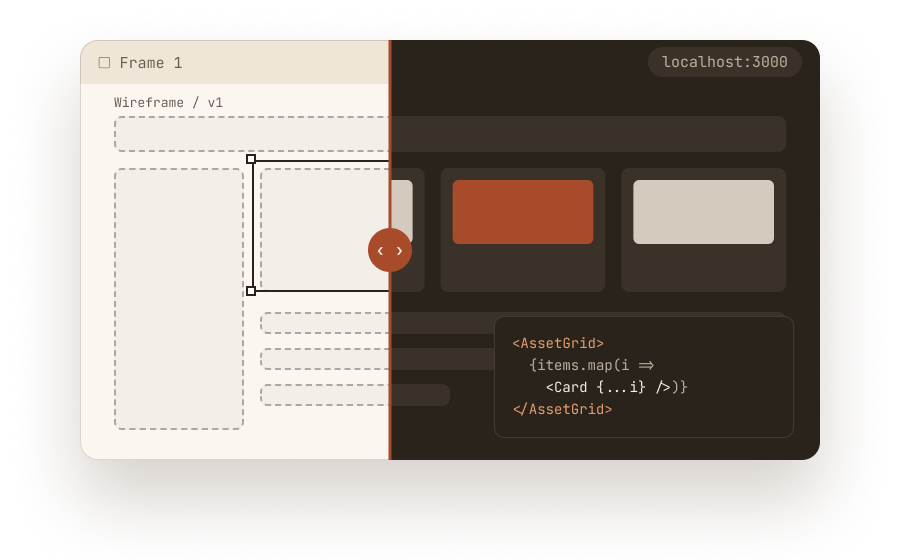
The tool was Claude. The team had been building the product with it from the start. There was no point forcing my process onto a team that already had its own. If I wanted to contribute, I had to learn their language.
Learning a new design language
I took an online masterclass during the internship to learn Claude beyond the chat window: Design, Code, Cowork, and working with GitHub directly in the codebase. At the same time I learned how the team used staging, pull requests and code review.
My vocabulary changed fast: APIs, MCP, context windows, tokens, worktrees, subagents, deployment. Not words I expected to use as a UX student, but they became part of my design process.
From designing screens to designing in the product
My workflow became:
- Understand the product and business
- define user problems
- form hypotheses
- build in the product with Claude Code
- experience it in the browser
- refine
- pull request
- feedback
- iterate
The biggest difference was that I no longer stopped at a static design. I could build an idea into the working product, try it in the browser, notice what felt wrong and fix it. The distance between an idea and something testable became much shorter. My first shipped change was a notification drawer, so updates stopped competing with the work itself.
It wasn’t effortless. I still had to understand the problem, make the decisions, and recognise when a solution was confusing or unnecessary. Claude helped me move faster. It couldn’t decide what was worth building. That was still my job.
What my first internship taught me
A process is a tool, not a law. Research, design, development and testing overlap in real projects, and you often move forward with incomplete information. The process should serve the project, not the other way around.
Learn the tools your team actually uses. Professional design isn’t about defending your favourite tool. If the team works in Claude, GitHub and the browser, that’s where I need to be.
AI doesn’t replace design judgement. Someone still has to ask: Is this the right problem? Does it help the user? Does it fit the product? What could go wrong? The faster the tools get, the more these questions matter.
A first internship isn’t supposed to feel comfortable. I often felt like I was learning everything at once. Maybe that’s the point: not a place where you already know everything, but where you find out what you still need to learn.
What’s next
I started the internship expecting to learn how to design better screens. I finished it knowing how to understand a product, work with AI, build in the product and connect user needs to the codebase.
I’m returning to Cway for my next internship. By then the product may be live, with real user feedback waiting in Linear. I’m looking forward to it, even if someone stops me again when I open Figma.